



Before the Tube London Had a Problem
Imagine London in the middle of the 19th century.
The streets are crowded with horse-drawn carriages carts omnibuses pedestrians and an ever-growing population trying to move through the heart of the city.
Above ground London was running out of room.
So engineers proposed something that sounded almost impossible at the time:
What if the railway went underneath the city?
Today taking a train beneath London feels completely ordinary. In Victorian Britain it was revolutionary.
And on January 10 1863 that idea became reality.
The Metropolitan Railway opened to the public between Paddington and Farringdon Street becoming the world's first underground passenger railway. The original route was approximately 3.5 miles long and around 40000 passengers used it on its first day.
Among the stations on that historic railway was a name that would become inseparable from London:
Baker Street.
Baker Street January 1863
Long before the modern Tube map electric trains or the familiar Underground roundel passengers descended into Baker Street to experience something the world had never seen before.
An underground railway.
Baker Street opened on January 10 1863 as part of the original Metropolitan Railway. London Transport Museum describes the station as part of the launch of a revolutionary idea: carrying passengers beneath the congested streets of Victorian London.
But the experience would have looked very different from taking the Tube today.
There were no sleek electric trains quietly entering illuminated platforms.
The original railway used steam locomotives underground.
Picture the scene.
Brick arches overhead.
Gas-lit platforms.
Wooden railway carriages waiting beside the tracks.
Steam drifting through the station.
And beyond the platform a dark tunnel disappearing underneath London.
For Victorian passengers stepping onto that platform in 1863 underground travel wasn't simply transportation.
It was something entirely new.
The World's First Underground Railway
The Metropolitan Railway originally connected Paddington with Farringdon Street passing through central London with seven stops.
Every one of those original stops remains in use today.
Much of the railway was built using a technique known as cut and cover.
Instead of boring deep tunnels like later Tube lines workers excavated large trenches along the planned route constructed the railway inside them and then covered them again.
It was disruptive.
It was ambitious.
And it changed urban transportation forever.
The idea proved enormously popular. Approximately 40000 people rode the Metropolitan Railway on its first day.
London had demonstrated that a railway could operate underneath a major city.
Other cities would eventually follow.
The modern metro had begun.
What Did Baker Street Station Look Like in 1863?
Walk through Baker Street today and more than 160 years of railway history surround you.
But try to remove the modern signs electric trains advertisements and crowds.
Imagine the station illuminated by warm Victorian lighting instead.
Brickwork and broad arches shaped the platforms.
Tracks disappeared beneath the streets.
Steam locomotives pulled wooden passenger carriages through the underground railway.
There was something almost theatrical about it—a glowing platform surrounded by darkness.
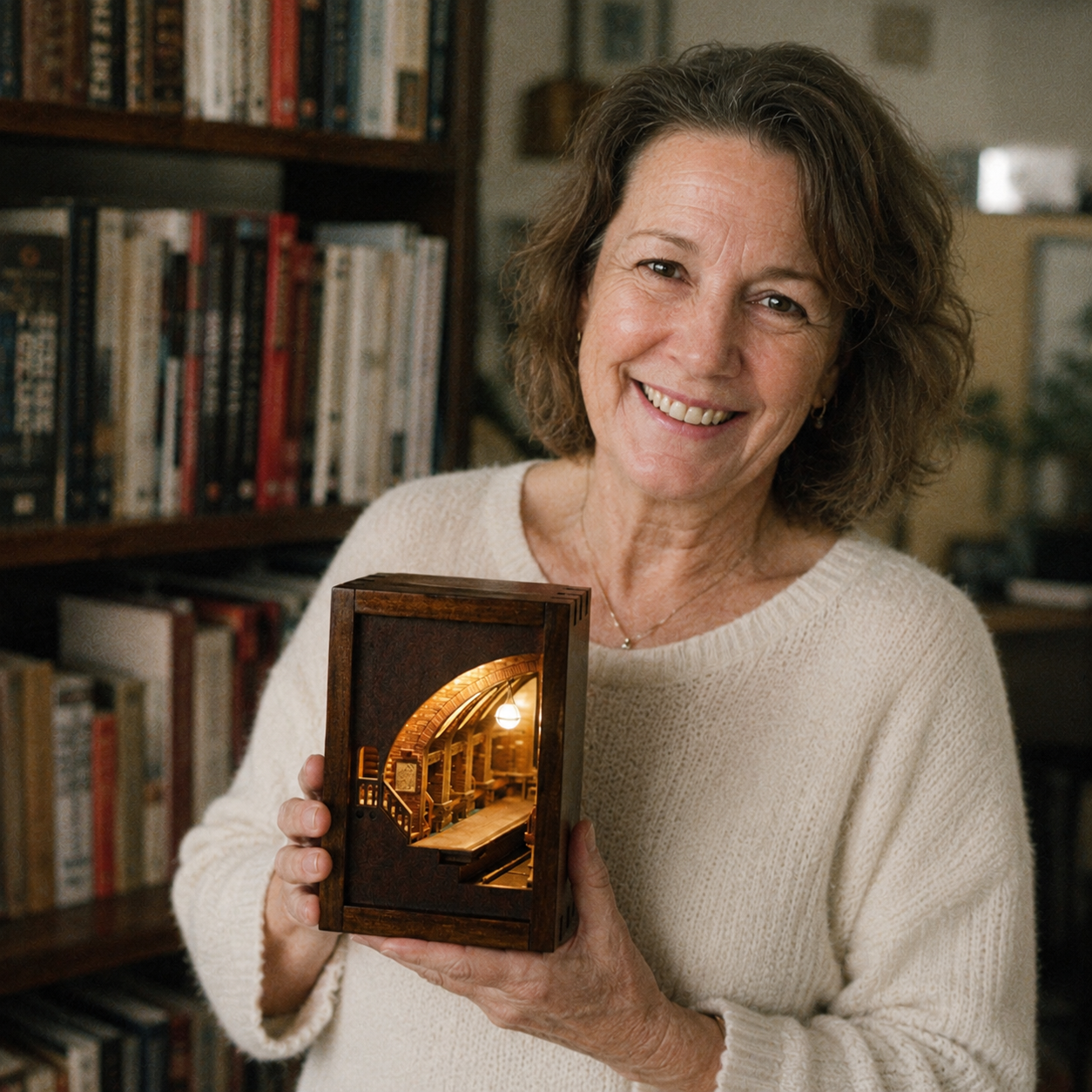
That contrast became one of the main inspirations behind our Baker Street 1863 Book Nook Kit.
Rather than recreating a modern London Underground station the miniature returns to the beginning.
London 1863.
The Platform Is Quiet. The Lamps Are Still Burning.
There's something fascinating about an empty railway platform.
Especially an old one.
A station is normally a place between places. People arrive wait for a few minutes and disappear again.
But remove the passengers and suddenly the architecture becomes the story.
That's the feeling we wanted Baker Street 1863 to capture.
Warm platform lights illuminate the brick arches while the railway tracks continue toward a dark tunnel.
There are no crowds.
No announcements.
No train entering the station.
Just a platform waiting beneath Victorian London.
It creates a simple question:
Has the last train already left—or has it simply not arrived yet?
A Tunnel That Goes Further Than Your Bookshelf
One of the most distinctive features of the Baker Street 1863 Book Nook is its sense of depth.
A real railway tunnel doesn't end neatly after a few inches.
It disappears.
So the miniature uses layered construction together with a mirror-enhanced perspective to visually extend the railway beyond the physical depth of the model.
Look through the arch from the right angle and the tracks seem to continue much farther into the darkness.
Your bookshelf may only be a few inches deep.
The railway doesn't seem to know that.
And that's exactly what makes the illusion work.
Instead of feeling like a miniature box sitting between books the scene begins to resemble a small opening into somewhere else.
From Victorian Engineering to Bookshelf Art
That's what makes historical book nooks particularly interesting.
You're not simply building a miniature.
You're rebuilding an atmosphere.
Brick by brick arch by arch and light by light, the Baker Street 1863 Book Nook recreates a small interpretation of the railway that helped transform London.
Once assembled it can sit quietly between books about history, architecture travel Sherlock Holmes railways or London itself.
Turn the lights off and it's a wooden miniature.
Turn them on and suddenly there is a railway platform between your books.
For a moment your bookshelf ends somewhere beneath Victorian London.
Why Baker Street?
Of all the stations connected to London's early Underground,Baker Street carries a particular sense of history.
It was part of the Metropolitan Railway when the world's first underground railway opened in 1863. Today, Baker Street remains a major London Underground station served by the Metropolitan Bakerloo Jubilee Circle and Hammersmith & City lines.
More than a century and a half of London transportation history exists in the same place.
London Transport Museum even runs a Hidden London experience centered on Baker Street and the origins of underground travel including historic spaces normally closed to passengers.
But Baker Street also carries something beyond railway history.
The name itself immediately evokes old London.
Foggy streets.
Brick buildings.
Gas lamps.
Victorian engineering.
Mysteries waiting around the corner.
It feels like exactly the kind of place where a doorway into another century might still exist.
A Book Nook for People Who Love Old Places
Some people want everything new.
Others find themselves drawn to places that show their age.
Old railway stations.
Libraries with worn wooden shelves.
Historic streets.
Victorian architecture.
Museums.
Train journeys.
Buildings where millions of people have passed through before.
If you're one of those people Baker Street 1863 was made with you in mind.
And that also makes it an unusual gift for someone who loves London railway history architecture miniature building DIY projects or historical places.
Instead of giving them another piece of London-themed merchandise you're giving them a place to build.
A tiny piece of 1863.
Next Train: 1863
More than 160 years have passed since passengers first traveled beneath London on the Metropolitan Railway.
The steam locomotives are gone.
The network has expanded far beyond its original route.
Baker Street itself is now connected to several Underground lines, carrying modern passengers through London every day.
But somewhere beneath all of that modern infrastructure the beginning remains.
January 1863.
Brick arches.
Warm lamps.
A railway disappearing into darkness.
And the strange excitement of stepping onto an underground train for the first time in history.
Baker Street 1863 brings a little piece of that moment back—small enough to fit between your books.
The platform is waiting.
Next train: 1863.
Explore the Baker Street 1863 Book Nook Kit
Build the brick arches illuminate the platform and watch the mirrored tunnel disappear beyond your bookshelf.
Bring Victorian London home one tiny piece at a time.
Share:
Christmas Book Nooks: A Cozy Little World for the Most Magical Time of Year
Build a Tiny World Together: Why Book Nooks Make a Wonderful Family Activity